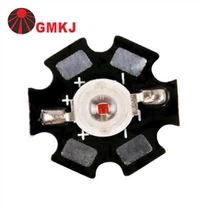
When we talk about LED lights, we most often tout their energy saving benefits—they're the most eco-friendly, energy efficient lighting option on the market, after all. But Fred Maxik, a founder of the Gwoup Syans ekleraj, which specializes in LED bulbs, is hoping to show that LED light fixtures contain myriad other untapped benefits, ranging from emotional to physical. To do so, he's developing "biological specific lights" that do not interfere with users' sleep cycles or melatonin production.
Koneksyon ki genyen ant limyè ak sante pwouve. Enstiti Nasyonal Sante Mantal te dekouvri an 1980 ke limyè blan klere te kapab siprime pwodiksyon melatonin. Kèk ane apre, chèchè Harvard yo te demontre ke ritm sirkadyèn yo ta ka deranje pa twòp ekspoze a limyè blan klere. Dènyèman, syantis yo te lye repwesyon melatonin pa sèlman nan lensomni, men tou, nan kansè nan tete.
Maxik thinks he can make a bulb that combats these effects, and in fact has health benefits instead. "With a biological bulb, you could read at night without experiencing the nagging irritability that can occur after using a computer or sitting close to a lamp near bedtime," according to New York Times. "And other bulbs — or the same bulb programmed via a network— could help make consumers feel more refreshed in the morning by choreographing their wake-up ritual. "We could even do things like lights for sterilization, with photo catalysts" for bathrooms in perhaps five to six years," added Maxik.
The LED's super power—the thing that makes an LED "health bulb" possible—lies in the fact that light emitting diodes are completely controllable. "Light-emitting diodes, after all, are semiconductors that can be programmed to emit light at precise wavelengths, colors and tones. Traditional light bulbs, the last vestige of the vacuum tube era, produce light with hot gases or wires," says NY Times. This valuable feature, which is found only in LED lights, will give consumers the ability to have greater control over their environment. Besides light bulbs with health benefits, LED lights that send signals and information, emit light to make people look more attractive, and combat jet lag are either already available or in the works. For instance, the photo above depicts an LED light bulb that NASA will use to adjust astronauts' circadian rhythms.
"Humans and artificial lighting have never been an ideal combination. Circadian disorders result from placing humans in unnatural situations. Maybe LEDs can restore some of the balance," says NY Times.